Principal Broker CE Compliance: Duties for Your Team
What RIBO's by-law and Spot Check program expect of principal brokers for their team's CE and compliance, with a practical routine to keep everyone on track.
RIBO treats continuing education (CE) as each broker's own responsibility. It also holds the principal broker responsible for making sure everyone they supervise complies. RIBO's FAQ calls this a dual responsibility. This post sets out what that means under RIBO By-Law No. 3 and the Spot Check program, and how to run CE oversight without it eating your September.
What the by-law requires of a principal broker
Section 6.1(d) of By-Law No. 3 lists what direction and supervision by a principal broker includes, without being limited to it. The principal broker must make sure that:
- every licensee they supervise complies with the applicable laws and with standards set by RIBO Council for licensees under a principal broker's supervision
- those licensees are given, and use, the insurance information they need to act without misconduct or incompetence
- trust accounts, books, records and accounts are kept as the Act requires
- errors and omissions, financial guarantee and fidelity insurance are maintained
- required filings are made on time
- renewal applications, fees and assessments are paid
- no one at the firm who is not registered acts as an insurance broker
- procedures and a written Plan of Supervision are established and followed to ensure compliance
Section 6.1(e) says the principal broker must exercise reasonable diligence in carrying out these duties. On CE specifically, RIBO's CE page says the principal broker will be responsible for ensuring that licensed individuals comply with RIBO requirements.
Your own CE comes first
Principal brokers need 10 CE hours each term, with at least 5 in Management and 1 in Ethics. The other 4 can come from any category except Professional Development. Deputy principal brokers and supervising brokers have the same requirement.
Missing it costs more than it does for other brokers. Under section 7.2(d) of By-Law No. 3, a principal broker who fails to meet CE has their appointment automatically removed and their registration suspended. They cannot be reappointed until the hours are complete. RIBO's CE page adds that the brokerage may be reviewed for failing the principal broker requirement, and section 8.2 requires an active firm to have a principal broker appointed at all times.
Delegating to deputies and supervising brokers
A principal broker can appoint deputy principal brokers and supervising brokers, but must set out their duties in writing (section 6.1(h)). Delegating does not move the responsibility: section 6.1(i) says the principal broker remains responsible for compliance despite any appointment. If a deputy runs CE tracking for the office, write that down, and keep checking the results yourself.
What RIBO looks at in a Spot Check
Spot Checks are RIBO's compliance audits of brokerages. One of the documents a principal broker may be asked for is the Continuing Education compliance certificates for the previous two terms (October to September) for all licensed individuals. The Office Processes module asks about the firm's supervision plan and CE, among other things.
CE record keeping is a common finding. In RIBO's 2024-2025 Spot Check Report, covering 60 completed Spot Checks, 31% of the brokerage cases reviewed did not have processes for monitoring or maintaining up-to-date records of their licensees' CE hours. RIBO also found cases where the recorded CE hours did not match the CE certificates. A spreadsheet total with no certificate behind it does not prove anything. We cover preparation in detail in preparing for a RIBO CE audit.
A practical CE routine for your brokerage
- Keep a roster that records each person's role. Principal, deputy principal and supervising brokers need 10 hours with no Professional Development; everyone else needs 8.
- Track hours by category, not just totals. Check Ethics and Technical (or Management for supervisors) and the 2-hour Professional Development cap for each person.
- Collect certificates when courses are completed, not in September. Match every logged hour to a certificate or letter of completion.
- Check accreditation before people book. RIBO's accredited course list shows hours, category and expiry date; email accreditation@ribo.com if a course is not listed.
- Flag new hires correctly. Their requirement starts on the first October 1 after they are registered.
- Set checkpoints during the term, such as one in the spring and one in early summer, so shortfalls surface while courses are still available.
- Handle leave early. You can apply to RIBO on a broker's behalf for an exemption or extension (section 7.1(b)). For long-term disability, RIBO wants a letter from you sent to licensing@ribo.com.
- Keep certificates for 5 years, which is what RIBO asks for Spot Check purposes.
- Write your CE monitoring steps into your Plan of Supervision so the process survives staff changes.
RIBO also sends a copy of any Notice of Suspension for missed CE to the supervising principal broker (section 8.2(d)). If one arrives, deal with it straight away. In IRIS, RIBO's online portal, principal brokers can see a live list of the brokers registered with their firm and email themselves a copy as a spreadsheet, which is useful for checking that your roster matches RIBO's.
What is changing
RIBO members approved amendments to RIBO's by-laws on November 4, 2026. Among them, Council can now set standards for licensees supervised by a principal broker, and section 6.1(d)(i) now requires principal brokers to make sure their licensees follow those standards. The by-law leaves the number of CE hours to Council; the hour requirements are published on RIBO's CE page.
Separately, RIBO consulted from November 2025 to March 31, 2026 on its supervisory framework, including standards to be built into each Plan of Supervision. RIBO says those proposals are not yet finalized. Watch RIBO's consultations page for the outcome.
RIBO's Guide to Spot Checks course, launched in October 2025, is designed mainly for principal and deputy principal brokers. It costs $50, takes about two hours, is not mandatory, and is accredited for 2 Management hours.
How CE Trackr helps
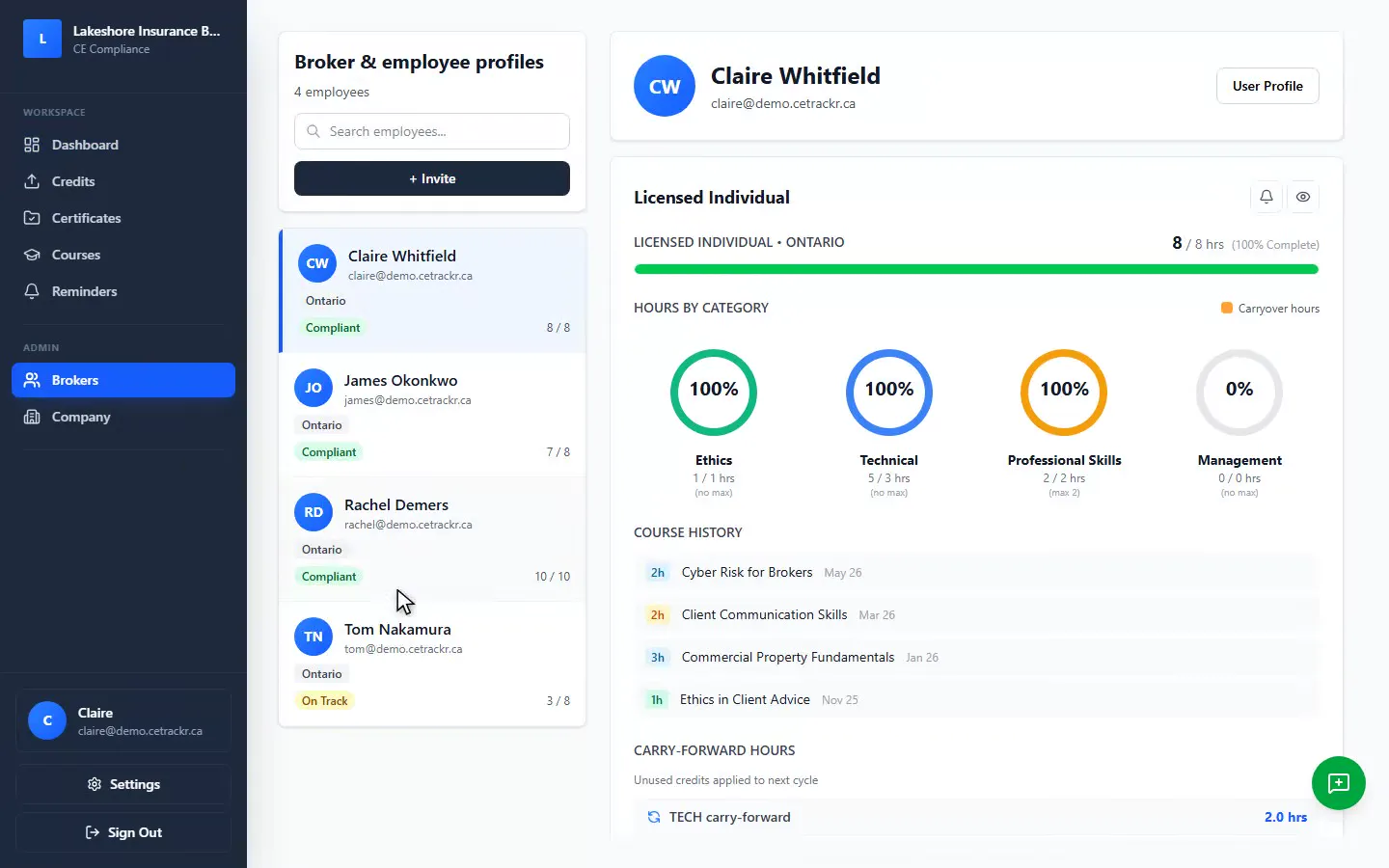
CE Trackr gives principal brokers a team dashboard for their brokers' CE. Brokers scan a photo or PDF of a certificate and the course, provider, date, hours and category are filled in. Reminders go out before deadlines, and 5 years of certificate history stays in one place. Start tracking free.
Frequently asked questions
Is the principal broker responsible for their team's RIBO CE?
Yes. Each broker is responsible for their own CE, and RIBO also holds the principal broker responsible for ensuring that the licensees they supervise comply.
How many CE hours does a RIBO principal broker need?
10 hours per term, with at least 5 in Management and 1 in Ethics. The other 4 can come from any category except Professional Development.
What happens if a principal broker misses their CE?
Under By-Law No. 3, their appointment as principal broker is automatically removed and their registration is suspended. RIBO says the brokerage may also be reviewed.
Can a principal broker delegate CE monitoring?
Yes, to a deputy principal broker or supervising broker, with duties set out in writing. The principal broker remains responsible for compliance.
Stop chasing certificates.
CE Trackr reads your certificates, tracks hours by category and reminds you before the deadline — for you or your whole brokerage.
Start tracking freeSources
- RIBO By-Law No. 3 (November 2026)
- RIBO: Broker Continuing Education Requirements
- RIBO: Frequently Asked Questions
- RIBO: The Spot Check Process (Compliance Audit Program)
- RIBO: 2024-2025 Spot Check Report
- RIBO: Guide to Spot Checks Course
- RIBO: Updated RIBO By-Laws 2026
- RIBO: Consultation on Enhancing RIBO's Supervisory Framework
- RIBO: Accredited Seminars and Courses
This article is general information, not legal or regulatory advice. RIBO's rules can change — always confirm current requirements with RIBO at ribo.com.