RIBO CE Categories: Ethics, Technical, Management, PD
RIBO's four CE categories explained: what counts as Ethics, Technical, Management and Professional Development, what doesn't qualify, and how to pick courses.
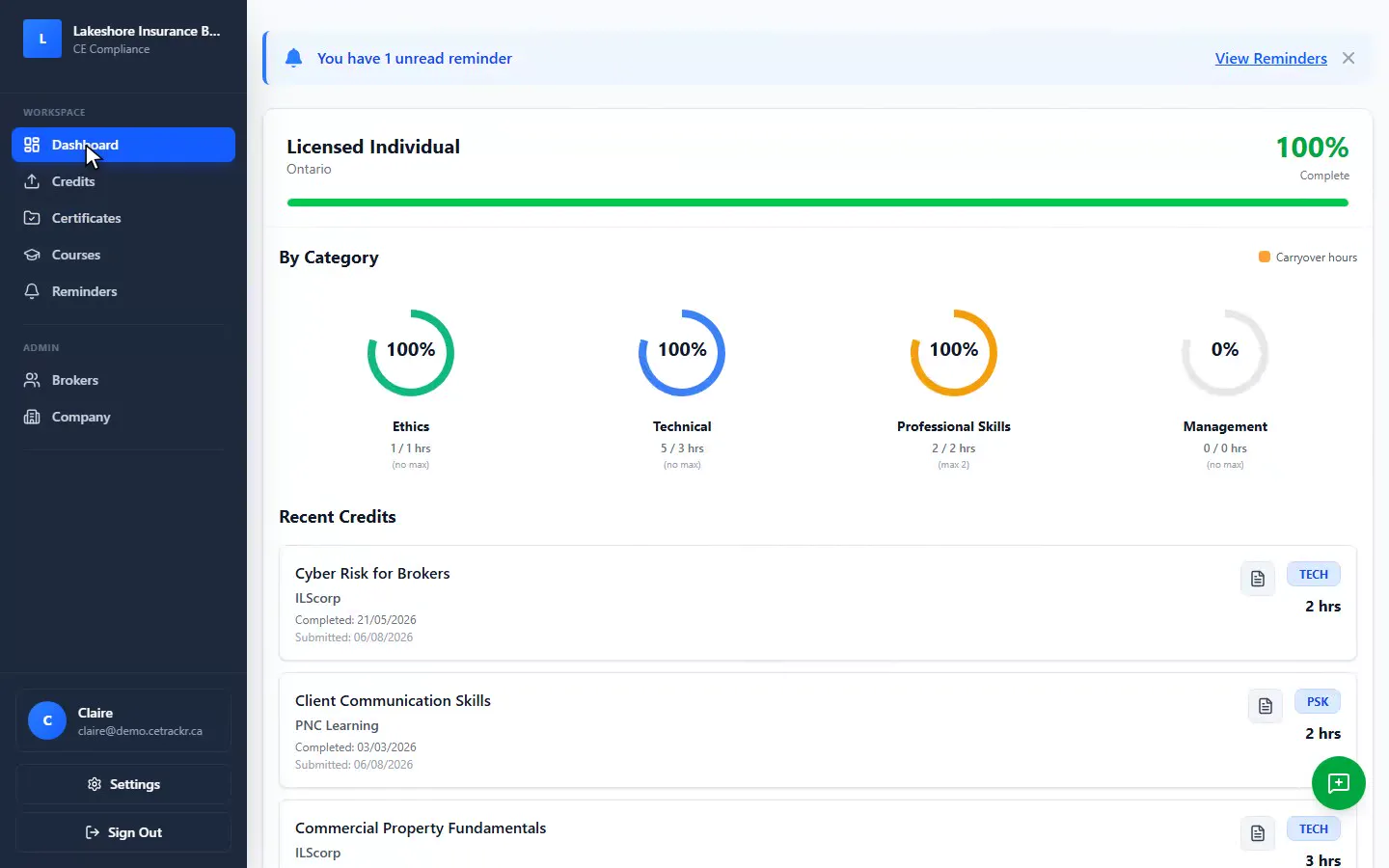
RIBO sorts every accredited continuing education (CE) hour into one of four categories: Ethics, Technical, Management and Professional Development. Your total hours matter less than how they split, because each role has category minimums and limits. This post explains what each category covers using RIBO's own definitions, and how to choose courses that actually fill your requirement.
The minimums by role
- Principal, Deputy Principal and Supervising Brokers: 10 hours per term, at least 5 Management and 1 Ethics, with the other 4 from any category except Professional Development.
- All other licensed individuals: 8 hours per term, at least 3 Technical and 1 Ethics, with the other 4 from any category. Professional Development is optional and no more than 2 hours of it can count.
Professional Development used to be called Personal Skills. RIBO's CE Record Sheet says that as of April 1, 2022, Personal Skills courses are treated as part of the renamed Professional Development category. If you see Personal Skills on an older certificate, that is why.
Ethics
RIBO says Ethics courses cover the rules or standards that govern daily decisions. Topics should examine ethical principles and the ethical problems that come up in business, such as recognizing and managing situations that could create a conflict with your professional and legal obligations to the consumer.
- Examples RIBO has approved: codes of conduct and ethical sales practices.
- Diversity, equity and inclusion topics can fit here, such as using language that does not exclude clients, or handling discrimination in the workplace.
- Courses on communicating with clients and customer service are Professional Development, not Ethics.
Technical
Technical courses build general insurance product knowledge or technical insurance expertise, including risk management and loss prevention.
- Examples RIBO has approved: insurance product and industry knowledge, and cyber liability and cyber data protection.
- Doesn't qualify: courses that are really about an insurance company, such as self-advertisement.
- Doesn't qualify: courses on insurance practices that only apply in other jurisdictions.
- Doesn't qualify: life insurance courses, because life insurance is not something RIBO brokers deal with.
Management
Management courses cover the Registered Insurance Brokers Act and its regulations, human resources, general management, accounting, and topics relevant to running a property and casualty brokerage.
- Examples RIBO has approved: employee management, sales performance management and brokerage management.
- Firms sometimes submit meeting minutes for Management hours. The content has to be relevant: updates on office renovations or staff changes would not qualify.
- RIBO's own Guide to Spot Checks course is accredited for 2 Management hours.
Professional Development
Professional Development covers the skills needed to work efficiently in a property and casualty brokerage as a customer service representative or producer, such as sales and marketing, communication and writing.
- Examples RIBO has approved: using Microsoft Office products, email, customer service, and sales practices for serving clients.
- It counts for up to 2 hours for brokers who are not principal, deputy principal or supervising brokers, and not at all for those who are.
What doesn't qualify in any category
RIBO only accredits instructional content directly applicable to its brokers. Its list of ineligible content, which it says is not exhaustive, includes:
- Accounting or financial planning courses
- Training on CRMs or broker rating tools, and any mandatory employee training
- Courses aimed at adjusters, underwriters or claims staff
- Standalone textbooks, e-books and articles. RIBO accredits presentations, instructor-led courses and self-study modules hosted on a learning management system.
- Content the applicant does not own
RIBO has not accredited internal systems training since April 2022. It also no longer accredits self-marketing or self-promotional material. Courses on broker management systems, rating tools and internal software that were accredited before then remain valid for CE credit, but will not be re-accredited when they expire.
How to pick courses
- Start from your gaps. Check your hours by category against the minimums for your role before you look at courses.
- Use the category the course is accredited in. RIBO's accredited course list shows each course's category, hours and expiry date, and can be filtered by category. Don't assume a course counts as Ethics because the title sounds like ethics.
- Check the course is still accredited. RIBO warns that some listings may have expired, changed or be missing, and asks you to email accreditation@ribo.com to verify.
- Watch the Professional Development cap. Extra Professional Development hours beyond 2 do nothing for your requirement, and supervisors get no credit for them.
- Count designation courses. RIBO publishes maximum hours for CIP, CAIB and other designation courses. For example, CIP courses are listed at 16 Technical hours each, except C16 and C132 at 20 Management hours, and CAIB 4 at 20 Management hours.
- Use short courses to top up. Since May 2024, RIBO accredits microlearning courses as short as half an hour, in quarter-hour increments.
- Don't repeat a course within 3 years. It won't count again until 3 years have passed since you last took it.
- Ask your principal broker whether any insurers offer RIBO-accredited courses, as RIBO suggests.
An example. A principal broker with 2 Management, 1 Ethics and 3 Technical hours logged has 6 hours: 4 short of the 10 required, and 3 of those 4 must be Management. Three Management hours, such as RIBO's own 2-hour Guide to Spot Checks course plus a 1-hour accredited Management course, and one more hour in Ethics, Technical or Management would finish the term. A Professional Development course would not help at all.
For the full set of hour rules, carry-over and the September 30 deadline, see RIBO CE requirements.
How CE Trackr helps
CE Trackr reads the category along with the rest of the certificate. Scan a photo or PDF and it fills in the course, provider, date, hours and category, so your log stays sorted by RIBO category without retyping. Reminders go out before deadlines, and principal brokers can see their team on one dashboard. Start tracking free.
Frequently asked questions
What are the RIBO CE categories?
Ethics, Technical, Management and Professional Development.
Do Professional Development hours count toward RIBO CE?
For brokers who are not principal, deputy principal or supervising brokers, up to 2 Professional Development hours count. For principal, deputy principal and supervising brokers, they do not count.
Is customer service training Ethics or Professional Development?
RIBO says courses on communicating with clients and customer service fall under Professional Development, not Ethics.
Do life insurance courses count for RIBO CE?
No. RIBO says life insurance courses do not qualify, as life insurance is not something RIBO brokers deal with.
How many CE hours is a CIP course worth with RIBO?
RIBO lists CIP courses at a maximum of 16 Technical hours each, except C16 and C132, which are 20 Management hours. Check RIBO's designation course list for other designations.
Stop chasing certificates.
CE Trackr reads your certificates, tracks hours by category and reminds you before the deadline — for you or your whole brokerage.
Start tracking freeSources
This article is general information, not legal or regulatory advice. RIBO's rules can change — always confirm current requirements with RIBO at ribo.com.